
Correct behavior in the tunnel
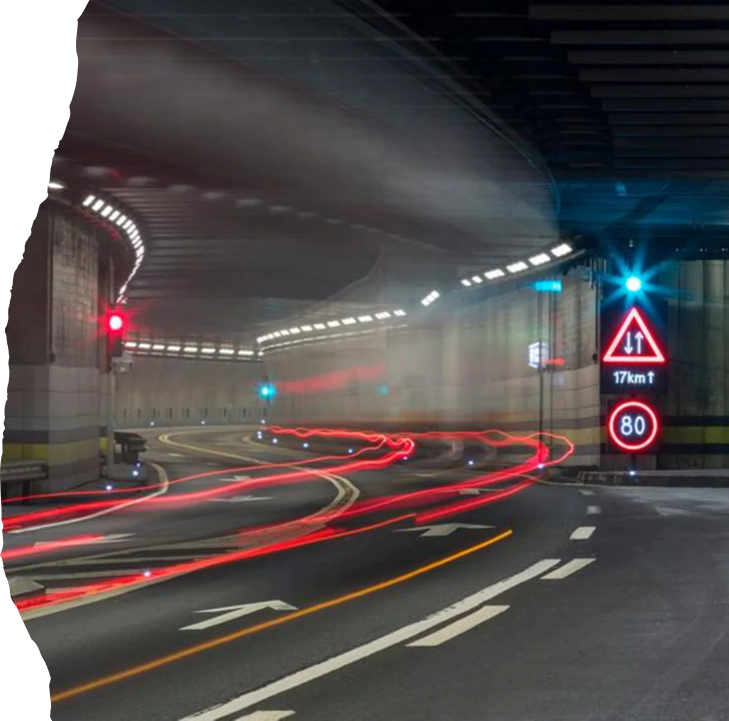
Before entering the tunnel
• Check tank filling.
• Switch on the radio (traffic information).
• Switch on low beam.
• Take off sunglasses.
• Pay attention to traffic lights and other traffic signs.
In the tunnel
• Maintain a safe distance from the vehicle in front.
• Do not exceed the maximum speed.
• Pay attention to safety devices such as emergency call stations and emergency exits.
• In a tunnel with oncoming traffic, always orientate yourself on the right side of the road, never drive over the center line.
• Do not turn or reverse.
• Only stop in an emergency, turn on the hazard warning lights.
What to do if...
Traffic jam in the tunnel
1. Switch on hazard warning lights.
2. Leave enough space for emergency vehicles to pass through.
3. Turn off the engine and remain in the vehicle.
4. Listen to the radio (traffic information).
5. Do not turn or reverse.
Breakdown in the tunnel
1. Switch on hazard warning lights.
2. If possible, drive the vehicle out of the tunnel. If this is not possible, stop the vehicle in a parking bay, on the hard shoulder or as close as possible to the right side of the road.
3. Switch off the engine, leave the ignition key in the ignition.
4. Leave the vehicle, pay attention to traffic, wear a high-visibility vest.
5. Find the nearest SOS niche and alert the operations center using the SOS telephone (do not use a cell phone).
What to do when an event occurs
Accident in the tunnel
1. Switch on hazard warning lights.
2. Stop the vehicle at a safe distance, as close to the right side of the road as possible.
3. Switch off the engine, leave the ignition key in the ignition.
4. Leave the vehicle, pay attention to traffic, wear a high-visibility vest.
5. Find the nearest SOS niche and alert the operations center using the SOS telephone (do not use a cell phone).
6. Provide first aid if necessary.
What to do in case of fire
In your own vehicle
1. Switch on hazard warning lights.
2. If possible, drive the vehicle out of the tunnel. If this is not possible, stop the vehicle in a parking bay, on the hard shoulder or very close to the right edge of the road.
3. Switch off the engine, leave the ignition key in the ignition.
4. Leave the vehicle, pay attention to traffic, wear a high-visibility vest.
5. Find the nearest SOS niche, alert the operations center using the SOS telephone (do not use a cell phone) and take out the fire extinguisher.
6. Only extinguish fires in the early stages. If the fire cannot be extinguished, leave the tunnel quickly via the marked emergency exits.
In someone else's vehicle
1. Switch on hazard warning lights.
2. Stop your own vehicle at a large safe distance from the burning vehicle, as close as possible to the right side of the road.
3. Do not turn or reverse.
4. Switch off the engine, leave the ignition key in the ignition.
5. Find the nearest SOS niche and alert the operations center using the SOS telephone (do not use a cell phone).
6. Only extinguish fires in the early stages. If the fire cannot be extinguished, leave the tunnel quickly via the marked emergency exits.
Observe signaling
Safety devices
• Parking spaces for broken down vehicles (display bays).
• Every 150 meters there are SOS niches with SOS alarm boxes (emergency telephone and two fire extinguishers each). If a call is made or a fire extinguisher is removed, an alarm will be triggered and the television monitors will be switched on. Section of the route is visible on the monitors in the police operations control center.
• Traffic information (radio announcements).
• Escape route markings every 25 meters indicating the distance to the escape door.
• Emergency exits that lead directly outside, into a neighboring pipe or into a safety tunnel.
• Escape doors every 300 meters with permanently lit green bars. In the event of an incident, bright white flashing lights improve the route to the escape doors.
• Traffic lights and lane light signals: These are switched on when changing lanes or closing lanes.